Preparing for the Basic Education Certificate Examination (BECE) requires more than just memorizing notes. Many students fail to achieve their desired grades not because they lack knowledge, but because they fail to communicate that knowledge to the examiner.
Below are the critical "danger zones" where candidates lose marks and the professional strategies to turn those weaknesses into strengths.
Why BECE Candidates Lose Marks and How to Secure Your Grade 1
The Time-Wasting Trap: Rewriting Questions
Many students enter the exam hall and begin by copying the question onto their answer sheet.
The Mistake: This wastes precious minutes and carries zero marks.
The Solution: Clearly write the Question Number (e.g., Question 1a) in the middle of the page or the margin as instructed. Dive straight into your answer. Use the time saved to review your work at the end.
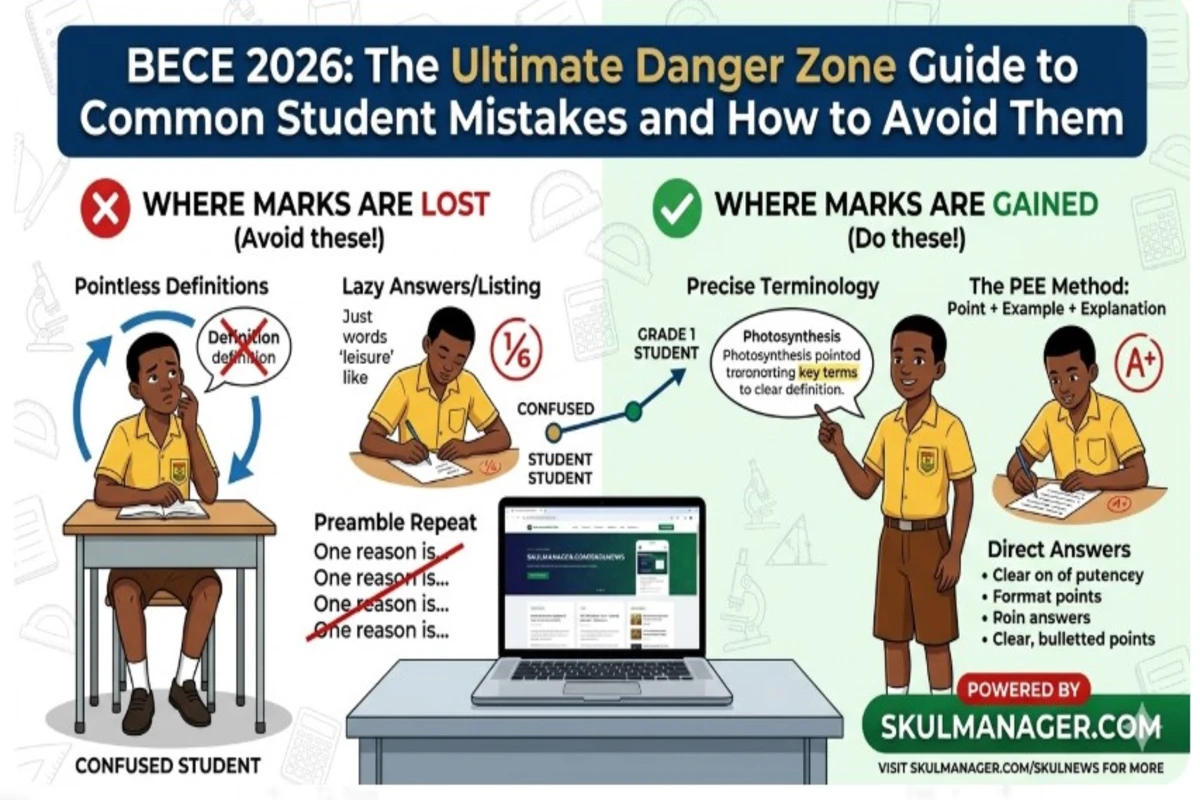
Avoid "Pointless" or Circular Definitions
A pointless definition is one that uses the word itself to define it or "goes around in circles" without providing a scientific or technical meaning.
The Mistake: Defining Photosynthesis as "the way plants make their food."
The Solution: Use precise terminology.
Better: "Photosynthesis is the process by which green plants manufacture their own food using sunlight, water, and carbon dioxide in the presence of chlorophyll."
The Danger of "Lazy" Answers
Examiners use a specific marking scheme where "Listing" a point might only earn 1 mark, but "Explaining" it earns 2 or 3.
The Mistake: If a question is worth 6 marks and asks for three benefits of tourism, writing a simple list like "It provides fun" is a "lazy" answer that gifts marks back to the WAEC.
The Power Strategy (The "PEE" Method): Point, Example, Explanation.
Lazy Answer: "It provides leisure."
Strong Answer: "It serves as a source of recreation and leisure. For example, sites like the Kakum National Park allow families to gather for fun, which improves social bonds and mental well-being."
The "Preamble" Pitfall
Students often think that repeating the question makes their answer look longer and more professional. In reality, it irritates examiners and hides your actual points.
The Mistake:
-
- "One reason why parents organize naming ceremonies is..."
- "Another reason why parents organize naming ceremonies is..."
Solution: Get straight to the point. Use a single introductory sentence if necessary, then use bullet points or clear headers.
Correct Format: "Parents organize naming ceremonies for the following reasons:
-
-
- To give the child an identity within the community.
- To welcome the soul of the infant into the physical world."
-
Statements Without Evidence (Missing Examples)
An answer without an example is often considered incomplete, especially in Social Studies, RME, and Integrated Science.
- The Mistake: Stating a fact but failing to prove you understand its application.
- The Solution: Whenever you state a principle, add "For instance..." or "An example is...". This confirms to the examiner that you haven't just memorized the text—you actually understand the concept.
Technical Precision: Handwriting, Grammar, and Units
Small "mechanical" errors can lead to a massive drop in your Stanine grade.
Handwriting: If an examiner cannot read your "b" from your "d," they cannot award the mark. Keep it bold and clear.
Units of Measurement: In Math and Science, a number without a unit is often wrong. Writing "50" instead of "50cm³" or "50kg" can cost you the entire mark for that calculation.
Scientific Spelling: Misspelling "Mitochondria," "Rhizome," or "Sovereignty" suggests a lack of mastery.
Summary Checklist for Candidates
|
Instead of Doing This... |
Do This Instead! |
|
Rewriting the question |
Writing the Question Number clearly |
|
Giving 1-word answers |
Using the Point + Explanation method |
|
Repeating the question preamble |
Using direct bullet points |
|
Ignoring units (kg, m/s) |
Double-checking every numerical answer |
|
Using messy handwriting |
Writing legibly and leaving spaces between answers |
Now that you know why BECE candidates lose marks and how to secure your grade 1, it is time to implement the knowledge shared.