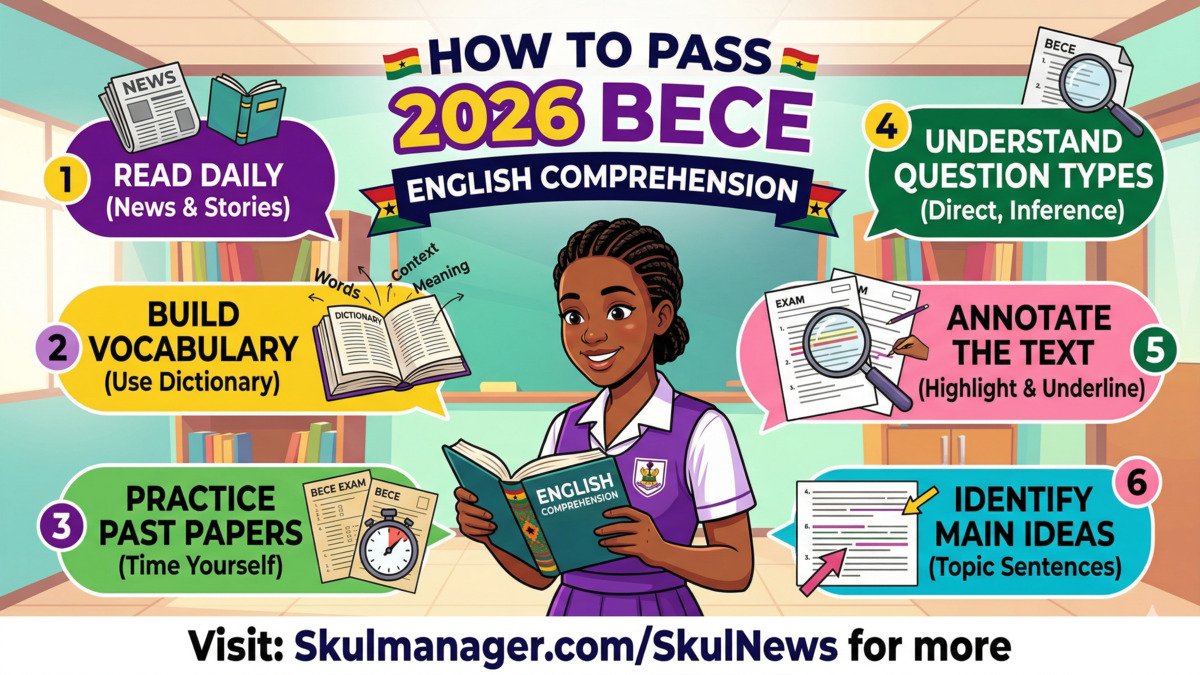
This research and experience-based write-up on how to pass 2026 BECE English Comprehension on May 4th, 2026, will help students do well in this section of the BECE paper. The English language will be the first paper to be written by Basic Education Certificate Examination (BECE) candidates when the BECE kicks off on Monday, 4th May, 2026. As one of the four core subjects at the BECE, candidates have no option but to make very good grades in their first paper.
The big question is, “How to pass 2026 BECE English Language?" This article will cover every aspect of the English language paper to help students and teachers prepare adequately.
The writer has taught the English language for 26 years and believes that these tips shared here, when followed by students, can help them excel at the BECE.
It will offer pro tips and strategies that, when followed, will help candidates excel in all sections of the paper. Students and teachers will find the areas to watch discussed in here also useful for the ongoing preparation.
Passing the BECE English paper is easier than many students know but that will demand that the right basic rules and things are done in the examination hall. From now until the examination starts, students must apply these tips and study habits.
Total Scores to target for a good pass
Students who aim at making good grades in the BECE English Language paper must target a minimum of 85 out of 100 in the examination hall. This means that students must obtain at least 35/40 in the English Language objective test paper. In addition to that, the candidates need to work hard to secure at least 50/60 in section B of the paper.
To further break the section B score of 45/60 down further, we need to carefully look at the components of the section of the English language paper.
The following scores are ideal if a student is to secure the 45/60 minimum score in paper 2
Comprehension – a minimum of 17/20
Composition – a minimum of 26/30
Literature - a minimum of 7/10
This will add up to 50/60 for section B and 35/40 for the section. This gives a total of 85/100 which should be good enough to secure a grade 2 or 1 depending on other factors such as the highest score in the subject for the year among others.
Now that we know the targeted scores across all sections of the English language paper, let us go a step further to know what to do, tips for ensuring we do not lose marks.
We will now cover the BECE English Comprehension aspect of the subject to help students make the best grades.
How to Score High Marks in BECE English Comprehension
The BECE English Comprehension section of the paper covers four key sections.
The four aspects of the English comprehension section are the direct comprehension passage questions, phrasal verb/idiom-related questions, synonyms-related questions, and the summary aspect.
Direct comprehension passage questions:
These are the direct and implied comprehension questions that demand that students use information provided in the passage to answer questions asked. Students must not provide answers that are outside the passage unless the examiner asks for their own opinions.
Method 1
- Read the questions quickly, then read the passage.
- As you do this, write the question numbers of the questions against the sentences that contain the answers.
- Then reread the passage again to improve your understanding and grasp every detail you missed at the first reading. In all these, read the passage with rapt attention to understand the information shared in it.
- Pay attention to the words underlined and used in the passaged and how they are used.
- While doing this, scan the text for quick answers as explained above.
- Write your answers carefully ensuring that you avoid spelling errors, grammatical mistakes among others.
Method 2.
Here, read the passage before reading the questions and follow the steps provided in method 1 above.
For instance, if the passage is about pollution and the passage mentioned that “According to Mr. Mensah, who was speaking to illegal miners, pollution has led to the destruction of water bodies, and lives are lost in illegal mining pits. Due to illegal activities, rivers have “lost their old glory," then a question is asked.
e.g., What are the effects of pollution according to the passage?
What are the two causes of water pollution?
Students who want to score the full mark allocated to this question must not provide answers that are not mentioned in the passage even if those answers are correct.
- Also avoid the use of pronouns to replace nouns mentioned in the passage.
- Do not recopy the question before answering. Only write the correct question number and then provide the best answer.
- Again, do not lift the entire answer from the passage; instead, use simple and best-fit compound sentences to present the answers. Let us answer the question above on pollution.
Answer: Mr. Mensah stated that water bodies are destroyed and lives are lost through illegal mining.
Follow the tips and strategies to secure very high marks in your BECE English Comprehension section.
Phrasal verb/idiom-related questions
To effectively answer such questions, let us keep in mind the following.
- Read more and work on your understanding of various idioms and phrasal verbs. Often there are two of such questions in every BECE English language comprehension.
- Avoid using one-worded answers and phrases to answer these questions.
- Give a clear explanation of what it means.
- The explanation you give must often related to the passage.
- Keep the explanation in context; thus, the explanation you give must relate to the passage.
From the passage extract, what does “lost their old glory” mean?
Possible Answers – Just one of these answers will be worth the full marks for the question.
- The water, which used to be clean, clear, and safe, is now heavily polluted and toxic due to illegal mining (galamsey).
- The natural beauty and life-sustaining quality of the water bodies have been destroyed.
- The rivers no longer serve the community or provide the benefits they once did.
Synonym-related questions in comparison.
This is one of the subsections in the BECE English language comprehension where students must score everything, yet many of them make avoidable errors.
Keep in mind the following keys. The word or phrase you provide as a replacement for an underlined word or phrase must fit into the passage without the passage or the sentence losing its original meaning.
The answer or word or phrase provided must be grammatically correct, and the words making it up must be spelled correctly since a wrong spelling renders the answer incorrect.
The answer must be in context; thus, do not just think about a word but an answer that fulfills the purpose and usage of the word you are replacing.
For instance, "The man butchered the goat for the feast. The underlined word can be replaced with either “killed” or slaughtered without any challenge.
But in another sentence, Mr. Kuma, the farmer, killed the boy with his tricycle on his way home. Though in the first sentence, "butchered" could be replaced with "killed," in the second sentence relating to Mr. Kuma, we cannot use the word "butchered" since it is out of context and does not fit the kind of situation or issue mentioned.
Based on the context of the sentence provided, here are three words that can replace "killed" to maintain the meaning, along with the reasons why "butchered" is inappropriate for this specific scenario.
Crushed
Why it fits: Since a tricycle is a heavy mechanical object, "crushed" accurately describes the physical impact of a vehicle running over or hitting someone. It maintains the gravity of the incident while providing a clearer picture of how the farmer's tricycle caused the fatality.
Fatally injured
Why it fits: This is a more formal and descriptive way to state that the boy died as a result of the accident. It emphasizes that the injuries sustained from the tricycle were the direct cause of death, which fits well if the sentence is being used in a report or news context.
Struck
Why it fits: In the context of road accidents, "struck" is the standard term used to describe a vehicle hitting a pedestrian. While "struck" on its own can sometimes imply only an injury, in this context it serves as a direct substitute for the act that led to the boy's death.
Why "Butchered" does not fit the context:
The word "butchered" is unsuitable for this sentence for the following reasons:
Implication of Intent and Method: To "butcher" implies a deliberate, gruesome, and manual act, often involving a blade or tool (like a knife or axe). It suggests a high degree of violence and intentional cruelty.
Accidental Context: The sentence describes a vehicular incident involving a farmer on his way home. This implies a tragic accident. Using "butchered" would wrongly suggest that the farmer went out of his way to use his tricycle as a weapon to dismember the boy, which contradicts the natural flow of the sentence.
Nature of the Object: A tricycle is used for transportation or hauling. It is not an instrument used for "butchering." Therefore, the word creates a "clash" in the reader's mind because it describes a type of violence that a vehicle cannot physically perform in that manner.
The Summary Questions
Do well in the English summary; ensure that.
- You do not lift entire passages or sentences.
- Use the exact proper nouns used in the sentence or paragraph you are summarizing and avoid replacing them with pronouns.
- If the question says, "In no more than 10 words, maintain that target.
- Avoid the use of linking phrases including "and"; these words end up increasing the number of words in your sentence summary.
Your comprehension skills and vocabulary richness will be the game changer as you write and solve the English comprehension questions. Reading different books on diverse issues goes a long way to help improve your vocabulary. Your student’s companion is excellent material for working on your vocabulary, synonyms, antonyms, idioms, and phrasal verbs, among others. It is not too late to make the student companion your best friend as you prepare for the BECE English Language paper.
This write-up is mainly based in experience as an English Teacher & research.