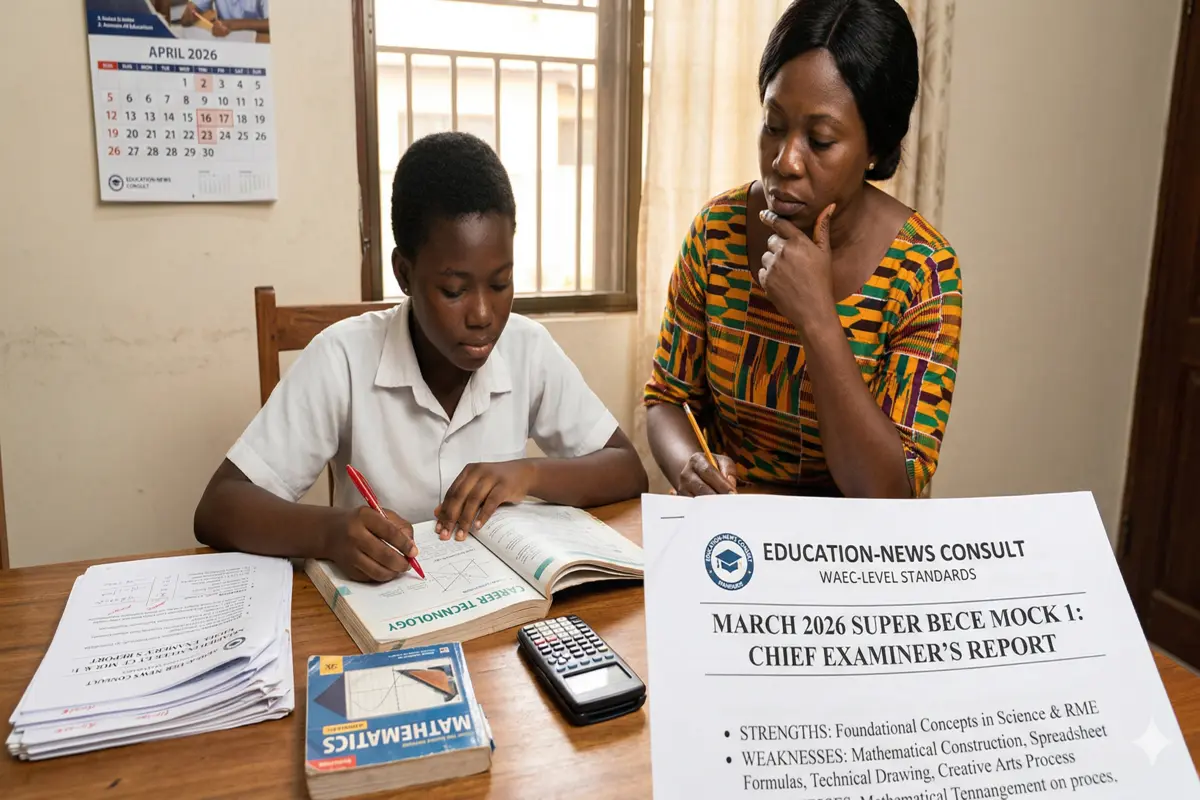
The Education-News Consult is pleased to release the detailed 2026 BECE Home Mock Chief Examiner’s Report for candidates. The report touches on areas that students need to work on as the BECE draws nearer. Every information captured in this report must be taken seriously as they have serious implications when students enter the BECE examination hall from Monday, 4th May, 2026.
The report is key because it highlights key issues such as students’ general performance, strength, weaknesses and recommendations for all the nine subjects examined in March.
Registration for the 2026 BECE Home Mock for April opened.
The April 2026 Final BECE Home Mock has started, and registration is underway for new and existing candidates/parents. The final mock will test your ward beyond the limit and cover our last set of areas likely to be examined during the 2026 BECE. Register or Login for the April Home Mock here
Parents who are hearing about this service for the first time and want their wards to do well at the BECE are encouraged to register their wards for both the March and April Home Mocks or one of them as part of the student’s final preparation efforts.
The BECE Home Mock is one of its kind in Ghana and beyond, and with our new smart dashboard released in March after 5 years of BECE Home Mock service, any student or parent can get the best out of the service without any challenge.
New parents can register their candidates here, while existing parents can log into their smart dashboard here to either check their results or pay the next month’s mock fee for their wards to take the mock.
SHS Choices Engine is our new addition to our current services.
We have also introduced this new service where you can use your ward's school mock, home mock, and others to test their chances of getting placed in preferred programmes, schools, and institutions. Visit SHS CHOICES and use it for a small fee to keep the site up and running. It helps prevent guesswork in school and programme selection, tells you the likelihood of your ward being placed or not, uses your ward's raw scores to filter and restrict schools they do not qualify for per the raw scores you enter. this means that, you
CHIEF EXAMINER'S REPORT ON THE MARCH 2026 SUPER BECE MOCK 1
GENERAL COMMENTS
The March 2026 Super BECE Mock 1 was organized by Education-News Consult for candidates in their respective homes to assess their readiness for the upcoming BECE. The standard of the papers was comparable to that of previous years' WAEC examinations.
The examination covered a wide range of subjects, including Computing, Mathematics, French, Career Technology, Science, and others. Most candidates showed a fair understanding of the fundamental concepts; however, some persistent weaknesses across subjects were observed, particularly in practical applications and technical drawing.
CANDIDATES' PERFORMANCE BY SUBJECT
MATHEMATICS
- Candidate Strengths: Many candidates demonstrated proficiency in basic arithmetic operations, simplification of indices, and identifying members of sets.
- Weaknesses: * Geometry and Construction: Several candidates struggled with the use of a ruler and pair of compasses for accurate geometric constructions.
- Word Problems: Interpreting and solving algebraic word problems, particularly those involving ratios and proportions, proved challenging.
- Data Representation: While many could calculate values for a pie chart, the actual drawing of the chart was sometimes inaccurate due to poor use of protractors.
- Recommendations: Teachers should emphasize the practical use of mathematical instruments and provide more exercises on translating real-world scenarios into algebraic equations.
COMPUTING
- Candidate Strengths: Candidates performed well in the objective section, particularly on questions related to basic hardware and general internet use.
- Weaknesses: * Spreadsheets: There was a noticeable weakness in writing accurate Excel formulas and functions (e.g., COUNTA, SUM, AVERAGE) based on a provided assessment sheet.
- Networking: Many candidates could not correctly identify or state the functions of networking devices like hubs, routers, and switches.
- Technical Procedures: Detailing specific procedures, such as resizing a picture in PowerPoint or explaining the importance of file extensions, was poorly handled.
- Recommendations: Hands-on practical sessions in spreadsheet and presentation software should be increased. Candidates must understand and master the differentiation clearly between various networking hardware.
CAREER TECHNOLOGY
- Candidate Strengths: Most candidates could identify basic tools and common food groups.
- Weaknesses: * Technical Drawing: Candidates had difficulty identifying and stating the functions of different line types (e.g., continuously thick vs. continuously thin lines).
- Material Properties: Explaining technical terms like "ductility," "malleability," and "tensile strength" for resistant materials was a major hurdle.
- Safety and Maintenance: While students knew basic safety rules, they struggled to justify why working safely is more productive than working fast in a workshop scenario.
- Recommendations: More focus is needed on the theory of technical drawing and the scientific properties of materials used in metalwork and woodwork.
FRENCH
- Candidate Strengths: Candidates were generally successful in filling out basic personal information forms.
- Weaknesses: * Redaction (Composition): Writing a descriptive essay in French within the word limit (40–60 words) remains a significant challenge, with many students making numerous grammatical and spelling errors.
- Vocabulary: Limited vocabulary was evident in descriptions of their homes and daily routines.
- Recommendations: Students should be encouraged to practice daily writing exercises in French and expand their vocabulary related to common objects and places. Solve likely exam questions when it comes to Essays and Form filling.
SCIENCE
- Candidate Strengths: Good performance was noted in topics related to feeding relationships (food chains) and identifying renewable energy sources.
- Weaknesses: * Human Anatomy: Explaining the structure and function of the villi in the human alimentary canal was difficult for many.
- Physics Calculations: Solving problems involving effort, load, and efficiency of machines was poorly executed.
- Chemical Equations: Writing and balancing the chemical equation for aerobic respiration proved to be a difficult task for most candidates.
- Recommendations: Teachers should use more diagrams and models to teach complex biological structures and provide more drill work on balancing chemical equations and solving physics problems.
SOCIAL STUDIES
- Candidate Strengths: Most candidates successfully identified environmental challenges and could name various sources of energy in Ghana (Solar, Hydro, Wind, etc.). There was also a good understanding of the transition to a Republic and the role of key historical figures.
- Weaknesses: * Application of Knowledge: While candidates could list environmental problems, they struggled to suggest practical, community-based solutions for a village setting like "Bobokrom."
- Tourism Impact: Many candidates could identify tourist sites but failed to critically analyze the negative socio-cultural effects of tourism, such as the transfer of diseases or environmental degradation.
- Recommendations: Teachers and students should use case studies to apply theoretical knowledge to real-life community problems. Mock debates or discussions on the "pros and cons" of national industries like tourism could improve critical thinking.
ENGLISH LANGUAGE
- Candidate Strengths: In the objective and literature sections, candidates showed a good grasp of plot points in "The Dilemma of a Ghost" and basic literary devices like similes.
- Weaknesses: * Essay Structure: In the formal letter and article writing, many candidates struggled with the correct layout (addresses, salutations, and titles).
- Argumentative Depth: For the topic on "hooliganism," many essays were repetitive and lacked three distinct, well-developed points.
- Grammar: Frequent errors in subject-verb agreement and the inconsistent use of tenses were noted in the narrative essays.
- Recommendations: Intensive practice on formal letter formats and article writing is required. Students should be encouraged to read widely to improve their vocabulary and sentence construction. Also resd article samples in English readers and past questions with solutions to master the writing styles required. These are two essay areas that students can be tested on
RELIGIOUS & MORAL EDUCATION (RME)
- Candidate Strengths: Candidates performed well in explaining the religious concept of stewardship and listing the physical changes associated with puberty.
- Weaknesses: * Comparison Skills: A significant number of candidates found it difficult to compare the Christian account of creation with Islamic stages of human creation effectively.
- Financial Ethics: While students could list "good uses" of money, they struggled to explain how "bad uses" (like bribery or gambling) specifically degrade human character and integrity.
- Recommendations: Teachers should use comparative tables to help students see the similarities and differences between various religious doctrines. Emphasis should be placed on the "moral lessons" derived from religious stories rather than just the facts of the story.
CREATIVE ARTS & DESIGN (CAD)
- Candidate Strengths: Candidates were generally able to identify local media used for weaving in Ghana and could name famous Ghanaian composers like Kojo Antwi and Amakye Dede.
- Weaknesses: * Design Process: Many candidates could not list the steps of the design process in the correct chronological order (Problem identification → Research → Brainstorming → Sketching → Evaluation).
- Weave Patterns: Identifying specific weave patterns (Plain, Twill, Satin) from diagrams was a major area of failure.
- Rehearsal Theory: Explaining the purpose of a rehearsal beyond just "practicing" was poorly handled.
- Recommendations: Practical lessons should include more visual identification of patterns and tools. Students should be involved in a mini "design project" where they must document each stage of the design process to solidify the theory.
GENERAL RECOMMENDATIONS TO CANDIDATES
- Read Instructions Carefully: Many marks were lost because candidates did not follow specific instructions, such as the number of questions to answer in each section.
- Practice Technical Drawing: Across several subjects, the ability to draw and label diagrams accurately was a common weakness. Candidates should practice sketching regularly.
- Improve Spelling and Grammar: Marks were often deducted for incorrect spelling of technical terms, even when the concept was understood.
In conclusion, the March 2026 Super BECE Mock 1 served as a critical diagnostic tool for both candidates and educators. While there is a commendable grasp of theoretical concepts in subjects like Science and Religious & Moral Education, the significant gap in practical application and technical accuracy cannot be overlooked.
The recurring challenges in Mathematics (geometric construction), Computing (software functions), and Career Technology (technical drawing) suggest that students are often learning in a purely abstract environment. These areas of weakness must be worked on now as they are likely to be accessed during the 2026 BECE. To bridge this gap before the final BECE, it is imperative that:
- Practical Drill Sessions: Schools and parents should prioritize hands-on practice, particularly for spreadsheet calculations and the use of mathematical sets.
- Instructional Compliance: Candidates must be trained to read and strictly follow rubric instructions to avoid losing avoidable marks.
- Remedial Focus: Educators should utilize the specific weaknesses identified in this report to tailor their revision notes for the remaining months.
If these recommendations are implemented with a focus on precision and clarity, the candidates are well-positioned to achieve the high grades required for placement into their preferred Senior High Schools.
Credit: This publicatiion was human generated| Report was analysed using advance AI while a final edit and updating was done by the editorial team at Skulmanager & Education-News Consult.