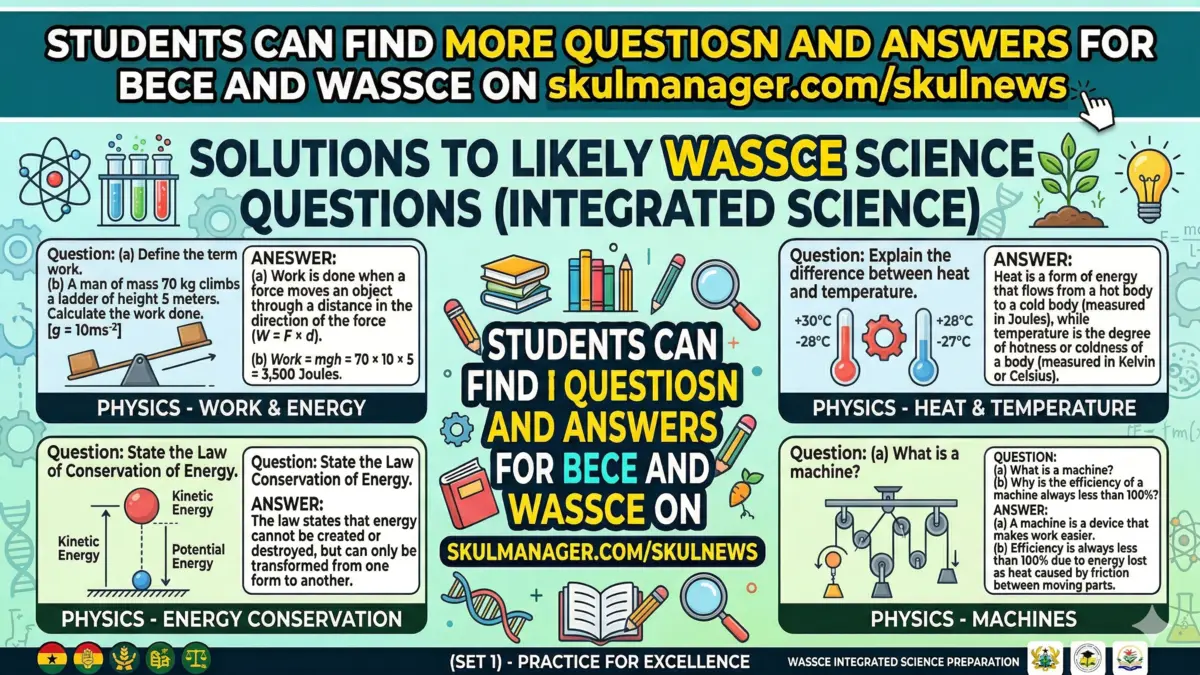
As SHS3 students get ready for the WASSCE 2026, we have shared here for revision purposes our first set of 2025 WASSCE Integrated Science Sample Questions and Answers.
Below are 20 structured Section B (Theory) questions and answers based on the l WAEC/WASSCE Integrated Science syllabus for Ghana. These cover the four main thematic areas: Biology, Chemistry, Physics, and Agriculture.
2025 WASSCE Integrated Science Sample Questions and Answers
Part 1: Physics and Energy
1. Question: (a) Define the term work. (b) A man of mass 70 kg climbs a ladder of height 5 meters. Calculate the work done. [$g = 10ms^{-2}$]
Answer: (a) Work is done when a force moves an object through a distance in the direction of the force ($W = F \times d$).
(b) $Work = mgh = 70 \times 10 \times 5 = 3,500$ Joules.
2. Question: Explain the difference between heat and temperature.
Answer: Heat is a form of energy that flows from a hot body to a cold body (measured in Joules), while temperature is the degree of hotness or coldness of a body (measured in Kelvin or Celsius).
3. Question: State the Law of Conservation of Energy.
Answer: The law states that energy cannot be created or destroyed, but can only be transformed from one form to another.
4. Question: (a) What is a machine? (b) Why is the efficiency of a machine always less than 100%?
Answer: (a) A machine is a device that makes work easier by allowing a small force (effort) to overcome a large force (load). (b) Efficiency is less than 100% due to energy lost as heat caused by friction between moving parts.
5. Question: Define Refraction of Light.
Answer: Refraction is the change in direction or bending of light as it travels from one medium (e.g., air) to another medium of different optical density (e.g., glass).
Part 2: Chemistry and Matter
6. Question: (a) What is an Isotope? (b) Give two examples of elements that exhibit isotopy.
Answer: (a) Isotopes are atoms of the same element having the same atomic number but different mass numbers. (b) Carbon ($C-12$, $C-14$) and Chlorine ($Cl-35$, $Cl-37$).
7. Question: Distinguish between a mixture and a compound.
Answer: In a mixture, components are physically combined and can be separated by physical means; in a compound, elements are chemically combined in a fixed ratio and cannot be separated physically.
8. Question: (a) Define Hard Water. (b) State one method of removing temporary hardness.
Answer: (a) Hard water is water that does not easily lather with soap due to the presence of dissolved calcium or magnesium salts. (b) Boiling the water.
9. Question: What is an Alloy? Name the constituents of Bronze.
Answer: An alloy is a uniform mixture of two or more metals (or a metal and a non-metal). Bronze consists of Copper and Tin.
10. Question: State two properties of an Acid.
Answer: 1. Acids have a sour taste. 2. They turn blue litmus paper red.
Part 3: Biology and Living Systems
11. Question: (a) What is osmosis? (b) State one biological importance of osmosis in plants.
Answer: (a) Osmosis is the movement of water molecules from a region of higher water potential to a region of lower water potential through a semi-permeable membrane. (b) It helps in the absorption of water from the soil by root hairs.
12. Question: List the components of human blood.
Answer: Red blood cells (Erythrocytes), White blood cells (Leucocytes), Platelets (Thrombocytes), and Plasma.
13. Question: (a) Define Respiration. (b) Distinguish between aerobic and anaerobic respiration.
Answer: (a) Respiration is the biochemical process where living cells break down food (glucose) to release energy. (b) Aerobic requires oxygen; anaerobic occurs in the absence of oxygen.
14. Question: What are the functions of the Liver? (State two).
Answer: 1. Regulation of blood sugar levels. 2. Detoxification of poisonous substances.
15. Question: Name the three parts of a typical seed.
Answer: Seed coat (testa), Embryo, and Endosperm (or Cotyledon).
Part 4: Agriculture and the Environment
16. Question: (a) Define Soil Erosion. (b) List two human activities that cause erosion.
Answer: (a) Soil erosion is the washing or blowing away of the topsoil by agents like water or wind. (b) Overgrazing and Deforestation.
17. Question: State the three primary plant nutrients (Macronutrients).
Answer: Nitrogen (N), Phosphorus (P), and Potassium (K).
18. Question: What is Crop Rotation?
Answer: It is the practice of growing different types of crops on the same piece of land in a pre-planned sequence to maintain soil fertility.
19. Question: (a) Define Pollution. (b) Name two air pollutants.
Answer: (a) Pollution is the release of harmful substances into the environment. (b) Carbon monoxide and Sulphur dioxide.
20. Question: State two ways of controlling Malaria.
Answer: 1. Sleeping under insecticide-treated mosquito nets. 2. Clearing stagnant water to destroy mosquito breeding sites.